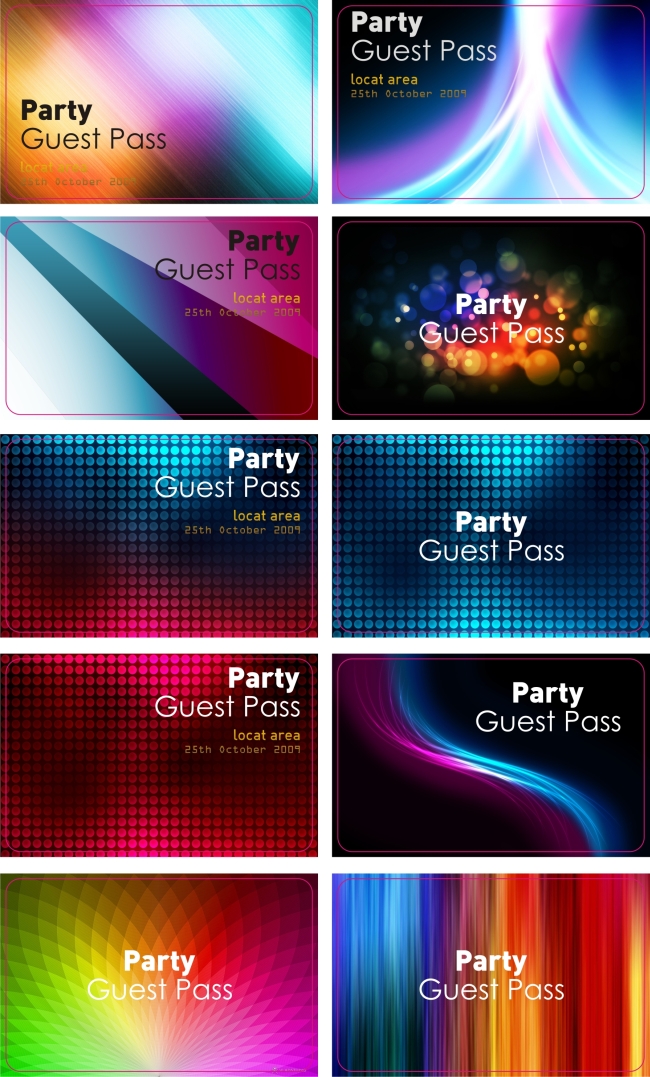
Color: multiple color, mixed color
Theme: fashion, photoshop texture
Status: Free vector pdf version available
Color: multiple color, mixed color
Theme: fashion, photoshop texture
Status: Free vector pdf version available
How to Make Hologram Sticker?
step1. Make hologram master origination (Master origination shooting system, 2D/3D or Dot-matrix)
step2. Recombine Dot-matrix master in size of160mm*160. 2D/3D master doesn’t need recombination. (Recombiner)
step3. Copy operation nickel shim from hologram master origination(Electronic Forming Machine)
step4. Emboss metallized PET film, transparent film(Narrow Web Hard Embosser)
step5. Laminate silicon liner together with embossed hologram film(Lamination Machine)
step6. Die-cutting, Slitting (Die-cutting Machine)
How to Make Hologram Hot Stamping Foil by Hard Embosser?
step1. Make hologram master origination (Master origination shooting system, 2D/3D or Dot-matrix)
step2. Copy operation nickel shim from hologram master origination(Electronic Forming Machine)
step3. Emboss hot stamping foil which is without hot melt adhesive(Hard Embosser)
step4. Coat hot melt adhesive(Hot stamping foil coating machine)
How to Make Transparent Holographic Film and Silver,Red, Green, … Holographic Film ?
step1. Produce small pcs customized design hologram master(Master origination shooting system, 2D/3D or Dot-matrix) .
step2. Recombine small master to big master upto size of 1500mm*600mm. (Big Recombinaiton Machine)
step3. Copy big size nickel master shim(Electronic Forming). We have around 80 general design master upto size 1500mm*600mm.
step4. Eemboss transparent pre-coated BOPP film, PET film, PVC film. Then you get transparent hologram film for packaging. Or to emboss pre-coated with color layer to produce silver, red, green holographic packaging film. (Soft wide web embosser)
step5. Vacuum Metalizer to metalize transparent hologram film. Then you get silver, red, green holographic packaging film. (There’re several good quality Vacuum Metalizer suppliers in China)
We also can use soft embosser to produce wide web hologram hot stamping foil with Vacuum Metalizer, Coating machines.
Brief of how to make hologram sticker.
Briefly discussed below is the process of making a typical two-layer ” Embossing Reflection Hologram “, by far the most common and cost-effective hologram , with two common sub-types, namely the two layer hologram (with a background image and a foreground image) and the three layer hologram (with a background image, a middle ground image and a foreground image).
Our holograms are made on a large stable table with a laser, lenses, mirrors and other optics. The table is composed of a large mass resting on a vibration isolation system to dampen any movement. Since the hologram records light waves, movement as small as one-quarter of a wavelength of light will ruin the hologram.
To make a hologram, the laser beam is split into two beams. One part of the laser beam is directed by mirrors and spread by lenses to illuminate the object. The laser lights the object, then bounces off and hits the holographic film or plate positioned in front of the object. The other portion of the laser beam, called the reference beam, is directed by mirrors and lenses to evenly illuminate the film. Where the two portions of the laser beam meet at the film, they interfere constructively and record the hologram.
This “constructive interference” of laser light’s waves is similar to the ocean’s waves traveling onto the beach. When two waves meet just right, their collision enlarges or amplifies their size. In holography, this wave amplification exposes the holographic film.
After exposure, the holographic film is developed, similar to black and white photography. After processing and drying, the hologram is ready for viewing. This series of steps results in a laser-viewable “Master” hologram.
White-light viewable holograms are created in a two step process. First, the laser-viewable Master is holographed. Then, a second hologram is made from the projected pseudoscopic image of the Master. This hologram can be reconstructed – viewed – in white light. The section on “Lighting Instructions” explains viewing a white-light hologram.
Lighting Instructions
A light is needed to illuminate a hologram. A hologram is illuminated by shining the light at the center of the hologram. For ease of viewing, this angle is usually about 45 degrees from the center of the vertical hologram to the light source. This lamp should be at least four feet above the hologram for the best results.
For best clarity, there should be no other lights striking the surface of the hologram.The quality of the light source that illuminates your hologram is very important. The sharper the light source, the sharper the image in the hologram. We recommend a light that uses a 12 volt, 50-75 watt MR-16 quartz halogen bulb.
Another light which works well is the Phillips Master Line, 60 watt PAR-16, narrow spread. These lights can be purchased at most lighting stores. The light should be at least four feet away from the hologram; and shine on the hologram from above at an angle of approximately 45 degrees. Reflection holograms use front lighting. Transmission holograms are illuminated from behind.
Design / Artwork / Origination
Working with you, our graphic team is going to transform your ideas into hologram by developing them in a best way. Designing marvelous visual effects and multi dimensional graphics with color and action unity is possible by using advanced computer techniques.
Artwork file in Corel Draw or Illustrator format is best. Artwork in Corel Draw file can be used for Master Origination Mold(nickel mold) shooting directly. Please save file in Corel Draw version 8 file. The Corel Draw artwork file should be converted into curves. So we can open it. Adobe Photoshop file, JPG, GIF, is ok, but not the best solution.
Mastering
Prepared model work is sent to hologram laboratory. Our expert physics engineers in their fields create Master hologram on a special sensitive emulsion by combining necessary photographic and holographic elements. As it happens in all holograms, this multi dimensional image is recorded by using laser beams and sensitive optical techniques.
Exposing “the positive” of each layer, one after the another, to laser light with the aid of specialized imaging devices such as specialized lenses and mirrors and recording the same on a surface of an ultra clean, photo sensitive and specialized glass plate, to originate “the Glass Master”. At the end of this intricate and time-consuming process, the original two dimensional image of the artwork gets “transformed'” into a “three dimensional” impression on the surface of “the glass master”, called the hologram. The hologram will diffract the seven colours of the spectrum (colours seen in a rainbow) and will produce “the depth effect” or the three dimensional (3D) effect, when it is viewed from different angles under any type of natural or artificial light, thereby giving it an extraordinary visual appeal. During holographic recording, secret information (e.g. code number) can be recorded and concealed in one of the layers of the hologram to make it machine readable only (that is, under special lighting conditions and with the aid of special viewing instruments) in order to impart the inimitable “optical security feature” to the hologram.
Electroforming
The laser beams that are loaded on master plates are transferred to the electroformed metal plates with the aid of chemicals. Transferring the multi-coloured, three-dimensional impression of the hologram from the surface of the glass master to the surface of a nickel plate to create ” the nickel master “. (After this, the glass master cannot be used any further and has to be discarded.). By the same process and from ” the nickel master “, additional nickel plates, also called ” shims ” are prepared for ultimate use in the embossing machine for mass production.
Embossing
Stamper shims are mounted in embossing machines. Transferring the multi-coloured, three-dimensional impression of the hologram from the surface of the shim to the surface of very thin, metallised polyester film roll, through optimal application of heat and pressure. A special chemical coating known as “Tamper Evident Coating'” on the base of the polyester film imparts an important additional security feature to the hologram, to detect any attempt at its unauthorized removal from the surface of a product or of its packaging or of a document.
Adhesive-coating and lamination: ( only for pressure sensitive label only )
The ” embossed ” roll is continuously coated on its reverse with a water-based / solvent-based pressure sensitive adhesive and dried and is thereafter continuously laminated with the silicon-coated surface of the release paper to make a laminated roll.
Die-Cutting
After lamination, the laminated roll is then duly in the size and the shape required by the customer by a very specialized automatic die-cutting machine. For jobs required in Spool Form the laminated rolls are slitted as per size. Holograms in Sheet Form are best suitable for manual affixations while Spool Form for automatic affixations.
Removal of the un-embossed portions of the metallised polyester film from and side-trimming of each sheet bearing several pieces of the hologram to make the sheet uniform in size and facilitate removal of holograms, one by one from the surface of the sheet.
Slitting(ifin roll) and packaging
Slitting sticker in roll format or cutting into panels. The sticker sheet will be packed 200 sheets one bag. The holograms are then finally passed through the quality control department, where each and every property of the hologram is thoroughly checked and finally these holograms are counted, packaged and shipped
|
Every Industry and any industry can use the Holographic products to enhance the image of their brands in the market as an genuine and authenticated brands. They are used for attractive product packaging, security applications (they are almost impossible to counterfeit), fancy gifts, etc. Holograms are new media of 3-D art, registration of priceless artifacts, etc. They are also used in new technology aircraft, automobiles, etc. A few leading companies are also working on Holographic video and TV systems. For your quick reference, some of the industry segemnts where Holograms are used very frequently are as follows:
In display holography ,the advent of pulsed lasers has made it possible to capture images of plants, animals and humans as well as inanimate objects. Holographic packaging materials have become popular and cheap. Security: The use of holograms on credit cards and bank-notes has reduced the opportunity for forgery Interferometry: If a “double exposure” hologram is made of an object before and after the object is subjected to stress, the change in the shape of the object due to that stress is recorded as a series of light and dark bands. In industrial situations this can be used in component testing and quality control. Medical records: Medical, dental and other records can be made both for teaching and for documentation. Measurements: Particle physicists make holographic records of bubble-chambers from which accurate measurements can be made. Display of artifacts: Many museums have made holograms of valuable articles in their collections, both for insurance purposes and to check for deterioration. In the former Soviet Union exhibitions of holograms of national treasures were sent to remote areas, enabling people to see and appreciate their national heritage without the necessity of travelling to major museums in Moscow or Leningrad (St. Petersburg) Holographic Optical Elements (HOEs): If a hologram is made of a lens, mirror or other optical element, it acts in the same way as that element. HOEs can be used, for example, in bar-code readers
|
|
|
|
|
Transparency Hologram ID Overlay
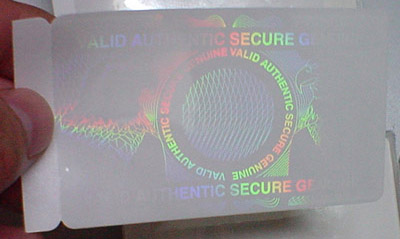 Transparent hologram Overlays for I.D. Cards using a transparent hologram film overlay on a digitally printed ID card protects the inks from excessive abrasion and wear, which extends the card life and enhance the security of your ID cards. The holographic overlay prevents alterations to the ID card information and combats copying or duplicating the ID card. The overlays presented here are “peel and stick” transparent labels which are manually affixed after the ID card is printed. The size of the overlay is slightly smaller than a standard PVC ID card.
Clear ID Holograms (Hologram Overlays, Holographic ID Overlays, Clear Holograms) made for ID Cards protection against fake ID cards and cheap Identifications. Transparent ID holograms are indeed transparent holograms and do not abstract the image on ID cards and you can see its Hologram image. ID Holograms are specially sized for ID Cards (Identification Cards) and are pressure sensitive, self adhesive holograms. Just remove paper liner to activate adhesive and apply ID Holograms over your ID cards!
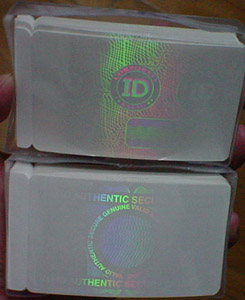
Transparent Hologram ID Card Overlay is transparent, self adhesive labels for use over identification cards, employee badges, and any other cards subject to tampering and/or forgery.
Custom Holographic Origination Overlays:
An overlay with a custom origination of your company name/logo offers the most security for your ID cards. After creating a custom security-grade origination (dot matrix or 2D/3D) for your company/organization, the design is registered with the IHMA global registry. The overlay is constructed in one layer. The hologram is embossed on 25 micron, 50 micron and 100 micron thick special polyester film. After embossing, a permanent acrylic adhesive is applied over the hologram. The overlay is then die cut to size. Total thickness is 30 micron (20 micron polyester + 10 micron adhesive). This product is available in “peel & stick” labels for easy application.
Standard and custom pouches are offered with the following features:
1. Material type: typically 4/6 (40% film /
60% hot melt adhesive) = 100 micron thickness.
2. Material thickness: 37 micron, 50 micron, 70 micron and 100 micron
3. Sizes: standard credit card, driver licenses, business card, military card , luggage tag, jumbo, custom sizes
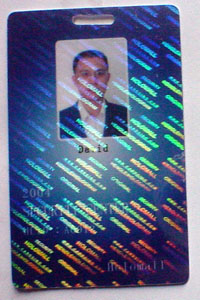
We produce holographic label, holographic film, holographic cards, holographic gift and sell mastering system, electronic forming machine, hologram embosser(including soft embosser and hard embosser), gluing (adhesive) machine and die cutting machine.
Hologram labels options:
The hologram labels can have up to 3 different layers.
The ordinary hologram labels will show different shining colours when looking from different angels.
The dynamic hologram labels have an additional dynamic effect which look like moving around when turning.
The labels can be tamper evident for secure usage (self destroyed when peeling off).
The background colour will be either silver or gold.
Turnaround time 12-15 days.

|
STYLE |
SIZE | 500 | 1,000 | 5,000 | 10,000 | 20,000 | 50,000 | 100,000 |
|
Ordinary Hologram labels |
<2 square cm | $350 | $350 | $400 | $450 | $530 | $650 | $900 |
| <4 square cm | $350 | $360 | $430 | $490 | $590 | $760 | $1,000 | |
| <7 square cm | $350 | $370 | $460 | $520 | $660 | $880 | $1,100 | |
|
Dynamic Hologram labels |
<3 square cm | $440 | $450 | $530 | $660 | $830 | $1,010 | $1,300 |
| <5 square cm | $440 | $470 | $590 | $760 | $950 | $1,200 | $1,500 | |
| <7 square cm | $440 | $490 | $630 | $860 | $1,080 | $1,360 | $1,700 |
RFID cards have been around for many years in various forms and mostly used in access control, security and financial applications. The technology utilized was most likely proprietary to their supplier and no open systems had existed. Most of these cards used passive RFID techniques in the frequency range of 125kHz to 135kHz. These cards were considerably thicker than most common photo ID cards, much more expensive, had limited memory space and could only be read one at a time.
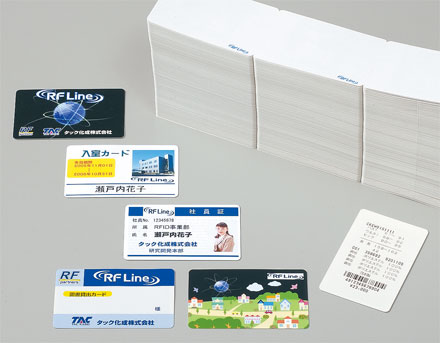
Most utilization of RFID cards involved “proximity”- “contact-less” cards. These cards replaced the popular contact cards that used actual metallic contacts on its surface, or embedded ferro-magnetic wires for communications. The “proximity” card applications provided a high degree of security, however the performance range of the card was typically limited to a couple of inches, at most.
During the past few years numerous standards have emerged and are currently being adopted by the RFID transponder manufacturers. ISO 14443 for “proximity” cards and ISO 15693 for “vicinity” cards, both recommend 13.56 MHz as its carrier frequency. These standards feature a thinner card, higher memory space availability and allow numerous cards in the field to be read almost simultaneously using anti-collision, bit masking and time slot protocols.
ISO 14443 proximity cards offer a maximum range of only a few inches. It is primarily utilized for financial transactions such as automatic fare collection, bank card activity and high security applications. These applications prefer a very limited range for security.
ISO 15693 vicinity cards offer a maximum usable range of out to 28 inches from a single antenna or as much as 4 feet using multiple antenna elements and a high performance reader system.
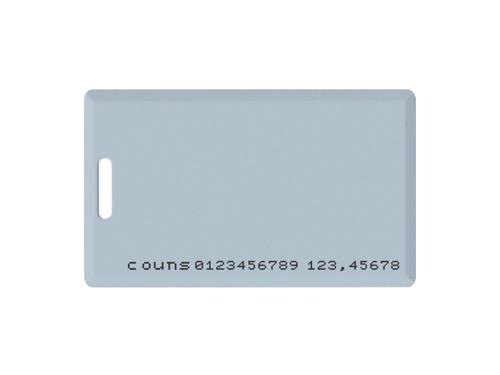
RFID Inlay
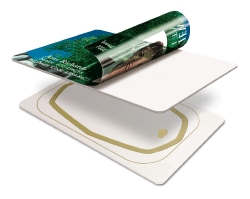
The manufacture of the card starts with the “inlay” or “foil” which contains the metallic antenna loop, silicon chip and associated components. Dynasys specializes in supporting Texas Instruments HF-I Tag-It inlays. These 13.56 MHz inlays meet ISO 15693 specifications and come in various sizes.
The PVC card itself typically meets the dimensions according to ISO 7810. An ISO card is 85.6mm long, by 54mm high, by .76mm thick.
ISO specification allows for a punchable area along the horizontal edge and a punchable area along the vertical edge without causing damage to the internally laminated RFID inlay. These punchable areas may limit the size of the inlay that can be used in the card. If the application does not require a punched hole in the card a larger inlay may be desired to attain optimum range performance.
Dynasys provides cards, laminated with various inlay sizes:
High Performance Cards
Getting maximum range from an ISO 15693 vicinity card, referred to as an “ISO” card for short, requires the proper integration of RFID reader, RFID antenna system and choice of card inlay.
In order to obtain optimum range from a passive RFID card the largest inlay size typically offers the best range. The magnetic flux energy from the radio field of the reader induces currents in the conductors of the inlay. Typically, the larger the loop aperture of the inlay’s antenna, the more energy that is captured and usable by the tag.
The relative angle that the card is presented to the reader antenna is a major factor in the available coupling. Antenna systems can be designed for parallel or perpendicular coupling to the card. If the card presentation angle is random, every effort should be made to capture energy at various angles and positions in the field.
Consideration should be given whether the card will be used in a badge holder, mounted vertical or horizontal, with or without a lanyard, pocket clip or pin. Also, proximity to anything metallic may cause significant degradation in performance range.
Anti-collision protocols will allow multiple cards to be detected within a common field. Just how well multiple cards are handled is a function of the reader’s intelligence and the antenna’s field pattern.
Making the Right Choices
Choosing the proper components for an RFID system is far from a trivial undertaking. Many options exist for selecting the reader, antenna system, and reader software as well as choosing the optimum compatible card components.
There are numerous places to obtain technical information and get some familiarity on RFID technology. This site is a good start. We also offer numerous get-acquainted RFID kits in case you want to get some hands-on experience.
Plasticcardonline INC are expert in RFID technology and are available to you to answer any questions you may have. We will help you to design an RFID system that will work best for your application.
Various types of materials are used to protect plastic cards from abrasion, wear, fading. Alternation, and duplications. Overlay varnishes and laminate patches are the most common materials used to enhance card durability and security.
Card durability has to do with how well the card withstands various forms of environmental stress. They include resistance to abrasion, such as passing the card through a magnetic stripe or bar code reader, protection from image fading when exposed to sunlight, and resistance to damage when immersed in water or exposed to chemicals.
Another important factor in applications such as drivers licensing is resistance to tampering, alteration, and/or replication. With the use of protective materials such as laminate patches with holograms, cards can be constructed to eliminate the potential of tampering and alteration.
Card security means that the card can be verified for authenticity. Techniques include the application of overlay varnish or overlaminate materials with hologram images. Use of these materials in constructing cards makes replication by anyone without access to the custom hologram image materials virtually impossible.
Overlay varnishes provide card protection, but have a much shorter life span that laminate patches – and offer very little security (with the exception of some hologram varnishes). Varnishes are not a solid covering and have multiple tiny holes in the surface, which allows the dyes to be drawn away from the card. This will cause the image on the card to blur and fade due to UV light, shift in color, or just wear away. The life expectancy of a plain plastic card is up to 2 years.
Laminate patches offer better protection than plain varnish, for both security and life expectancy. A patch laminate is, as its name implies, a polyester patch that is applied to the surface of the card after printing. Laminate patches, most often either .6 or 1.0 mil thick are applied via a hot roll laminating station. The life expectancy of a plastic card with a laminate patch is up to seven years.
Quick access to:plastic card | pvc cards | plastic card printing | plastic card company | card print |
plastic card factory | full color plastic card | RFID card | loyalty cards | Photo ID Cards | plastic business cards | Smart Cards | Die Cut Cards | clear frosted Cards | memership card | Gift Cards | Metal Cards | Blank Plastic Cards | Paper Cards
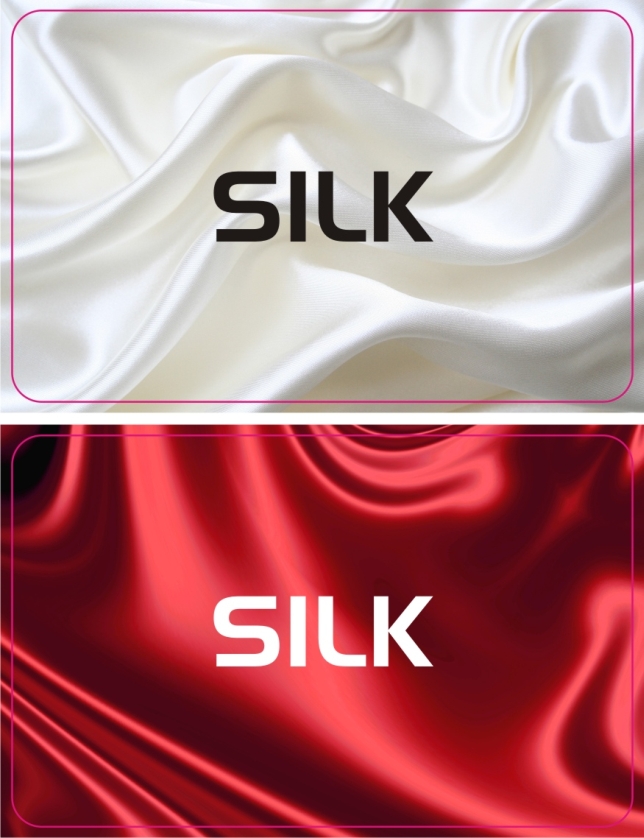
Color: white, red
Theme: silk texture, silk card background
Status: Free vector pdf version available
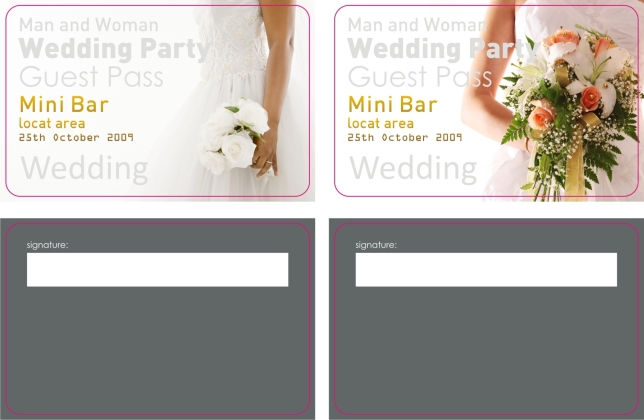
Color: white. gray
Theme: wedding, party, invitation, guest pass
Status: Free vector pdf version available
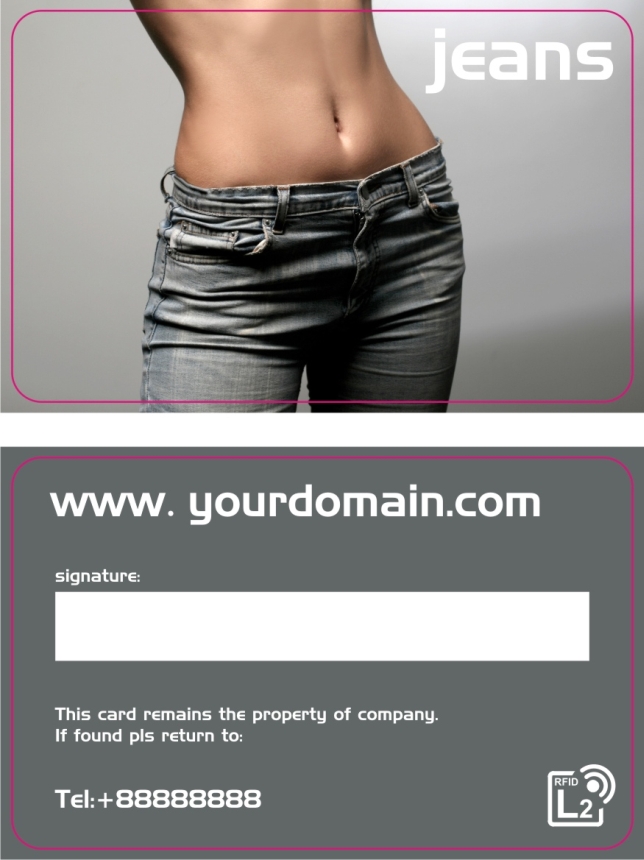
Color: jeans,gray
Theme: jeans
Status: Free vector pdf version available