Warning: Creating default object from empty value in /home2/finalart/plasticcardonline.com/blog/wp-content/themes/salient/nectar/redux-framework/ReduxCore/inc/class.redux_filesystem.php on line 29
Plastic card online
All Posts By

admin

Hologram labels

By | News | No Comments

We produce holographic label, holographic film, holographic cards, holographic gift and sell mastering system, electronic forming machine, hologram embosser(including soft embosser and hard embosser), gluing (adhesive) machine and die cutting machine.

Hologram labels options:

The hologram labels can have up to 3 different layers.

The ordinary hologram labels will show different shining colours when looking from different angels.

The dynamic hologram labels have an additional dynamic effect which look like moving around when turning.

The labels can be tamper evident for secure usage (self destroyed when peeling off).

The background colour will be either silver or gold.

Turnaround time 12-15 days.

STYLE

SIZE 500 1,000 5,000 10,000 20,000 50,000 100,000

Ordinary Hologram labels

<2 square cm $350 $350 $400 $450 $530 $650 $900
<4 square cm $350 $360 $430 $490 $590 $760 $1,000
<7 square cm $350 $370 $460 $520 $660 $880 $1,100

Dynamic Hologram labels

<3 square cm $440 $450 $530 $660 $830 $1,010 $1,300
<5 square cm $440 $470 $590 $760 $950 $1,200 $1,500
<7 square cm $440 $490 $630 $860 $1,080 $1,360 $1,700

RFID card: Radio Frequency Identification card

By | RFID card | No Comments

RFID cards have been around for many years in various forms and mostly used in access control, security and financial applications. The technology utilized was most likely proprietary to their supplier and no open systems had existed. Most of these cards used passive RFID techniques in the frequency range of 125kHz to 135kHz. These cards were considerably thicker than most common photo ID cards, much more expensive, had limited memory space and could only be read one at a time.
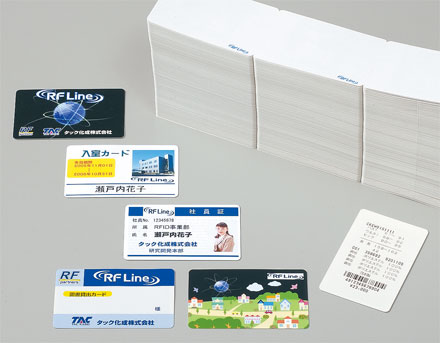
Most utilization of RFID cards involved “proximity”- “contact-less” cards. These cards replaced the popular contact cards that used actual metallic contacts on its surface, or embedded ferro-magnetic wires for communications. The “proximity” card applications provided a high degree of security, however the performance range of the card was typically limited to a couple of inches, at most.

During the past few years numerous standards have emerged and are currently being adopted by the RFID transponder manufacturers. ISO 14443 for “proximity” cards and ISO 15693 for “vicinity” cards, both recommend 13.56 MHz as its carrier frequency. These standards feature a thinner card, higher memory space availability and allow numerous cards in the field to be read almost simultaneously using anti-collision, bit masking and time slot protocols.

ISO 14443 proximity cards offer a maximum range of only a few inches. It is primarily utilized for financial transactions such as automatic fare collection, bank card activity and high security applications. These applications prefer a very limited range for security.

ISO 15693 vicinity cards offer a maximum usable range of out to 28 inches from a single antenna or as much as 4 feet using multiple antenna elements and a high performance reader system.
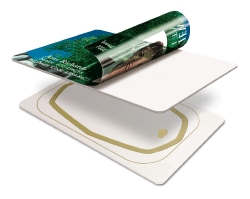
RFID Inlay
The manufacture of the card starts with the “inlay” or “foil” which contains the metallic antenna loop, silicon chip and associated components. Dynasys specializes in supporting Texas Instruments HF-I Tag-It inlays. These 13.56 MHz inlays meet ISO 15693 specifications and come in various sizes.

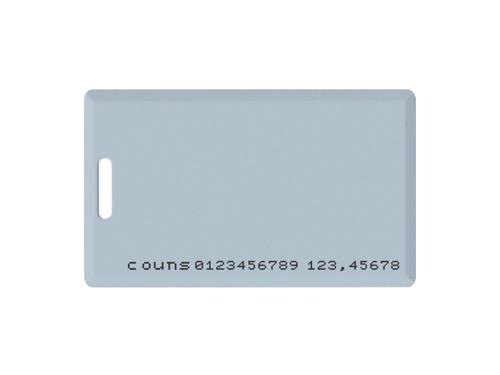
The PVC card itself typically meets the dimensions according to ISO 7810. An ISO card is 85.6mm long, by 54mm high, by .76mm thick.

ISO specification allows for a punchable area along the horizontal edge and a punchable area along the vertical edge without causing damage to the internally laminated RFID inlay. These punchable areas may limit the size of the inlay that can be used in the card. If the application does not require a punched hole in the card a larger inlay may be desired to attain optimum range performance.

Dynasys provides cards, laminated with various inlay sizes:
  • 22.5mm x 38mm – Miniature Rectangle
  • 35mm x 65mm – Access Control Rectangle
  • 45mm x 45mm – Square
  • 45mm x 76mm – Large Rectangle

High Performance Cards
Getting maximum range from an ISO 15693 vicinity card, referred to as an “ISO” card for short, requires the proper integration of RFID reader, RFID antenna system and choice of card inlay.

In order to obtain optimum range from a passive RFID card the largest inlay size typically offers the best range. The magnetic flux energy from the radio field of the reader induces currents in the conductors of the inlay. Typically, the larger the loop aperture of the inlay’s antenna, the more energy that is captured and usable by the tag.

The relative angle that the card is presented to the reader antenna is a major factor in the available coupling. Antenna systems can be designed for parallel or perpendicular coupling to the card. If the card presentation angle is random, every effort should be made to capture energy at various angles and positions in the field.

Consideration should be given whether the card will be used in a badge holder, mounted vertical or horizontal, with or without a lanyard, pocket clip or pin. Also, proximity to anything metallic may cause significant degradation in performance range.

Anti-collision protocols will allow multiple cards to be detected within a common field. Just how well multiple cards are handled is a function of the reader’s intelligence and the antenna’s field pattern.

Making the Right Choices
Choosing the proper components for an RFID system is far from a trivial undertaking. Many options exist for selecting the reader, antenna system, and reader software as well as choosing the optimum compatible card components.

There are numerous places to obtain technical information and get some familiarity on RFID technology. This site is a good start. We also offer numerous get-acquainted RFID kits in case you want to get some hands-on experience.

Plasticcardonline INC are expert in RFID technology and are available to you to answer any questions you may have. We will help you to design an RFID system that will work best for your application.

Card Durability and Security

By | News | No Comments

Various types of materials are used to protect plastic cards from abrasion, wear, fading. Alternation, and duplications. Overlay varnishes and laminate patches are the most common materials used to enhance card durability and security.
Card durability has to do with how well the card withstands various forms of environmental stress. They include resistance to abrasion, such as passing the card through a magnetic stripe or bar code reader, protection from image fading when exposed to sunlight, and resistance to damage when immersed in water or exposed to chemicals.
Another important factor in applications such as drivers licensing is resistance to tampering, alteration, and/or replication. With the use of protective materials such as laminate patches with holograms, cards can be constructed to eliminate the potential of tampering and alteration.
Card security means that the card can be verified for authenticity. Techniques include the application of overlay varnish or overlaminate materials with hologram images. Use of these materials in constructing cards makes replication by anyone without access to the custom hologram image materials virtually impossible.

Overlay varnishes provide card protection, but have a much shorter life span that laminate patches – and offer very little security (with the exception of some hologram varnishes). Varnishes are not a solid covering and have multiple tiny holes in the surface, which allows the dyes to be drawn away from the card. This will cause the image on the card to blur and fade due to UV light, shift in color, or just wear away. The life expectancy of a plain plastic card is up to 2 years.
Laminate patches offer better protection than plain varnish, for both security and life expectancy. A patch laminate is, as its name implies, a polyester patch that is applied to the surface of the card after printing. Laminate patches, most often either .6 or 1.0 mil thick are applied via a hot roll laminating station. The life expectancy of a plastic card with a laminate patch is up to seven years.

Quick access to:plastic card | pvc cards | plastic card printing | plastic card company | card print |
plastic card factory | full color plastic card | RFID card | loyalty cards | Photo ID Cards | plastic business cards | Smart Cards | Die Cut Cards | clear frosted Cards | memership card | Gift Cards | Metal Cards | Blank Plastic Cards | Paper Cards

Plastic cards: fantastic or fad?

By | News | No Comments

Darren Cottingham presents the case for plastic business cards. They could be that little extra branding boost that makes the difference.

Lesson number one in Japanese business card etiquette: When you receive another person’s card (or ‘meishi’ in Japanese), make a show of carefully examining it for around five seconds, and then make a positive remark about it. Do not shove it in your back pocket, write a note on it, or sling yours to other people across the boardroom table like you’re skimming a stone on a placid lake.

A business card in Japan is a ceremonial opportunity; in New Zealand it’s simply a functional set of contact details and a reminder of the company’s logo. Unless, that is, you have an exquisitely crafted plastic card that makes use of transparency and multi-layered colour. Personally, I’ve only twice had someone take my card and not acknowledge that it was something different – it’s a talking point, and I’m proud of handing my card out in all circumstances. So do plastic cards have the longevity of jeans, or are they simply a fad destined to go the way of Hello Kitty wedding towels?

First impressions

Other than your personal appearance (and odour), your business card is often the first impression of your company that a potential client or associate receives. As well as conveying the important contact details, it might also be the only chance you get at that time to differentiate yourself from your competitors with a positive brand image. If you’re wondering whether a crisp and tactile plastic card will impress more than a slightly dog-eared paper card you fish out of your wallet ask yourself this question: would your sister prefer to go out with Brad Pitt or a toothless Bolivian goat herder?

Image sells, but that’s not to say that an amazing paper card won’t sell better than a badly designed plastic card. It’s horses for courses, so when you’re jockeying amongst your competitors for the rich pickings, here are the pros and cons.

Plastic cards are recyclable and durable they’ll survive the washing machine, coffee spilled into your lap, and bending.You can layer different colours and use transparent areas to give real depth to the design, even leaving some areas completely transparent, and you’ll be in a minority if you have them.

However, they’re much more time consuming to design, and more expensive to print, particularly for short runs.You can’t write on them as well as paper cards, and if you don’t round the edges they’re quite sharp. Often thicker than paper cards, you’ll not fit as many in wherever you carry them – be careful not to run out! In many cases inks are mixed by hand so achieving a perfect colour match to printed material is difficult.

So: fantastic or fad? If you’re in an industry where image is important they could be that little extra branding boost that makes the difference. In some respects they’re more functional than conventional cards, and that’s probably what sums it up – who wants to be ‘conventional’ in today’s lightning-paced world?